

 Contact us


Project details
GTB Technologies Data Classification – A comprehensive data classification and control solution for enterprises.
In the era of digital transformation, data classification solutions have become a cornerstone of corporate security strategies. Data is constantly being created, stored, and shared across email, endpoints, file servers, databases, and the cloud. Consequently, organizations must accurately distinguish between public, internal, confidential, and top-secret data.
GTB Technologies’ data classification solution enables enterprises to discover, label, monitor, and control sensitive data throughout its entire lifecycle. This allows organizations to mitigate the risk of data loss, optimize DLP and SOC operations, and better meet compliance requirements—such as Decree 13/2023/ND-CP on personal data protection.
Leveraging capabilities in data classification, data discovery, and DLP, GTB Technologies facilitates data control across diverse environments. Enterprises can protect data residing on workstations, servers, email systems, file shares, databases, Microsoft 365, Google Workspace, OneDrive, SharePoint, and other cloud platforms.
Why do businesses need data classification solutions?
Data has become a strategic asset for every organization. However, as data volumes grow rapidly and become dispersed across various locations, it is increasingly difficult for businesses to maintain control over their entire digital asset portfolio.
Without visibility into where critical data resides, who is accessing it, and the channels through which it is shared, businesses struggle to protect their data effectively.
The Explosion of Unstructured Data
Corporate data is no longer confined to traditional databases. It exists in diverse forms—such as text documents, spreadsheets, emails, images, source code, and data stored on NAS systems, file servers, endpoints, and in the cloud.
The majority of corporate data is unstructured. This type of data is notoriously difficult to manage and prone to being overlooked. Consequently, data classification solutions help businesses bring unstructured data into a clearer governance framework.
Hybrid Work and the Cloud Reshape Security Models
Trends such as flexible work, remote work, and the migration of applications to the cloud result in constant data movement. Data flows across internal networks, personal devices, SaaS/IaaS platforms, and external storage systems.
In this environment, traditional network perimeter-based security is no longer sufficient. Businesses must control data based on its content, context, and sensitivity level.
Data classification solutions serve as a foundational layer that helps businesses protect data even when it is no longer within the scope of internal systems.
Cyberattacks increasingly target sensitive data
Cybercriminal groups, ransomware operators, and Advanced Persistent Threat (APT) actors frequently target customer data, financial records, trade secrets, and intellectual property.
Without the ability to identify sensitive data, an organization’s data protection efforts become reactive. Data classification enables organizations to identify critical digital assets, allowing them to implement protection policies tailored to specific risk levels.
Data classification solutions facilitate regulatory compliance
Data classification and control are no longer optional extras; they are critical requirements for information security governance and legal compliance.
Compliance with legal regulations and international standards
Data protection regulations increasingly mandate that organizations identify, classify, store, and process personal or sensitive data in a controlled manner.
Internationally, businesses may need to comply with standards such as GDPR, HIPAA, PCI-DSS, or ISO 27001. In Vietnam, Decree 13/2023/ND-CP on Personal Data Protection and the Law on Cybersecurity impose greater responsibilities on enterprises regarding data management, classification, and protection.
Optimizing DLP and SOC/SIEM system performance
Many enterprises have invested in DLP, SOC, or SIEM systems yet still struggle with excessive alert noise. A common cause is that security systems lack precise knowledge regarding which files contain confidential data, which are internal data, and which may be shared publicly.
When implemented correctly, data classification solutions help DLP systems reduce false positives. SOC teams can also prioritize genuine risk events more effectively, enabling a faster response to anomalous behavior.
Data classification serves as the foundation for DLP. DLP systems can utilize classification labels to block external data sharing, encrypt files, prevent copying to USB drives, or monitor the transmission of sensitive data.
Enhanced visibility and optimized storage costs
Through data discovery and classification, enterprises can identify duplicate, expired, and scattered data. Such data may reside on endpoints, file servers, NAS devices, cloud platforms, or other storage repositories.
This enhances security control while enabling enterprises to optimize storage costs, reduce data redundancy, and improve data management efficiency.
GTB Technologies – Enterprise Data Classification and Data Protection Solutions
GTB Technologies is a US-based data security solution provider established in 2004. The company focuses on developing solutions for data protection, insider risk management, and data loss prevention for organizations and enterprises.
GTB Technologies offers a data protection platform featuring both Network DLP and Endpoint DLP capabilities. The solution supports deployment across multiple platforms, including Windows, Mac, and Linux.
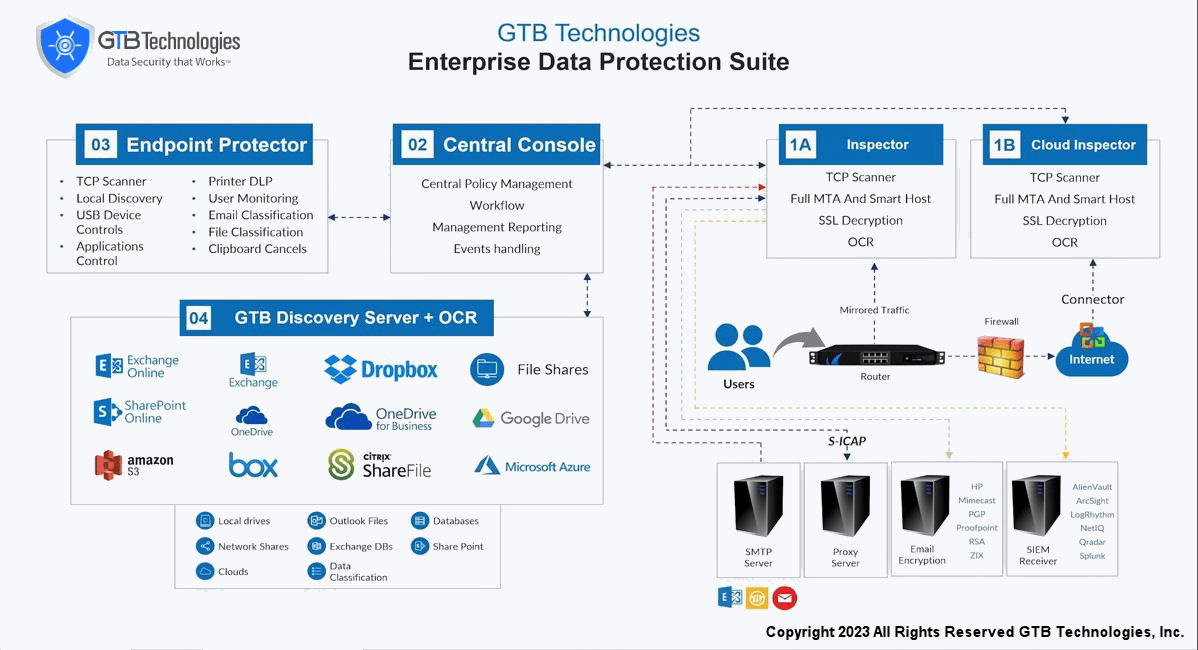
GTB Technologies helps enterprises address data security and compliance requirements. Key capabilities include data discovery, content classification, data monitoring, real-time policy enforcement, and the protection of an organization’s critical data.
With GTB Technologies, enterprises can build a comprehensive data protection platform. The system supports the discovery and mapping of sensitive data across endpoints, file shares, databases, email, cloud environments, and related systems.
GTB Technologies has also been recognized through numerous international reviews and awards in the data protection sector, including Gartner Peer Insights, SC Magazine Awards, and Cybersecurity Excellence Awards.

What does the GTB Technologies data classification solution help businesses achieve?
GTB Technologies Data Classification enables enterprises to establish a comprehensive data classification framework built on three pillars: People, Processes, and Technology.
The solution bridges the gap between data lifecycle management and internal risk control while protecting data based on content context.
This allows enterprises to proactively detect, monitor, and prevent activities that pose a risk of data loss. Control mechanisms can be applied whether the data is at rest, in use, or in transit.
Four-level data classification model
An effective data classification solution must clearly define data sensitivity levels, with corresponding protection measures for each.
With GTB Technologies, enterprises can establish a classification model comprising four levels: Top Secret, Secret, Internal, and Public.
1. Top Secret
This category contains the most sensitive data. Unauthorized disclosure could cause severe damage to the organization.
Examples include Board of Directors documents, M&A information, trade secrets, or critical business strategies.
Strict controls are required for this data category. Systems can prevent it from being sent, transmitted, or shared via unauthorized channels.
2. Secret
This category consists of sensitive data intended for sharing only within authorized internal circles.
Examples include customer data, financial records, employment contracts, or critical operational documents.
This data requires monitoring and control to prevent the risk of external leakage.
3. Internal
This data supports business operations and is not intended for public disclosure.
Examples include internal procedures, project reports, internal emails, or inter-departmental collaboration documents.
Protection measures may include access controls, watermarking, and monitoring of data usage.
4. Public
This category comprises data authorized for external release.
Examples include marketing materials, website content, annual reports, or approved communications.
Even with public data, a review process prior to release is necessary to prevent the accidental disclosure of unauthorized information.
Mechanisms of the GTB Technologies data classification solution
GTB Technologies supports multiple data classification and control methods. Enterprises can combine various mechanisms to enhance accuracy.
Keyword-based data classification
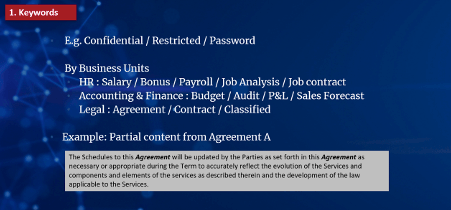
During operations, businesses generate numerous documents containing sensitive information. Examples include employee IDs, salary details, personnel lists, departmental data, financial information, and internal documents.
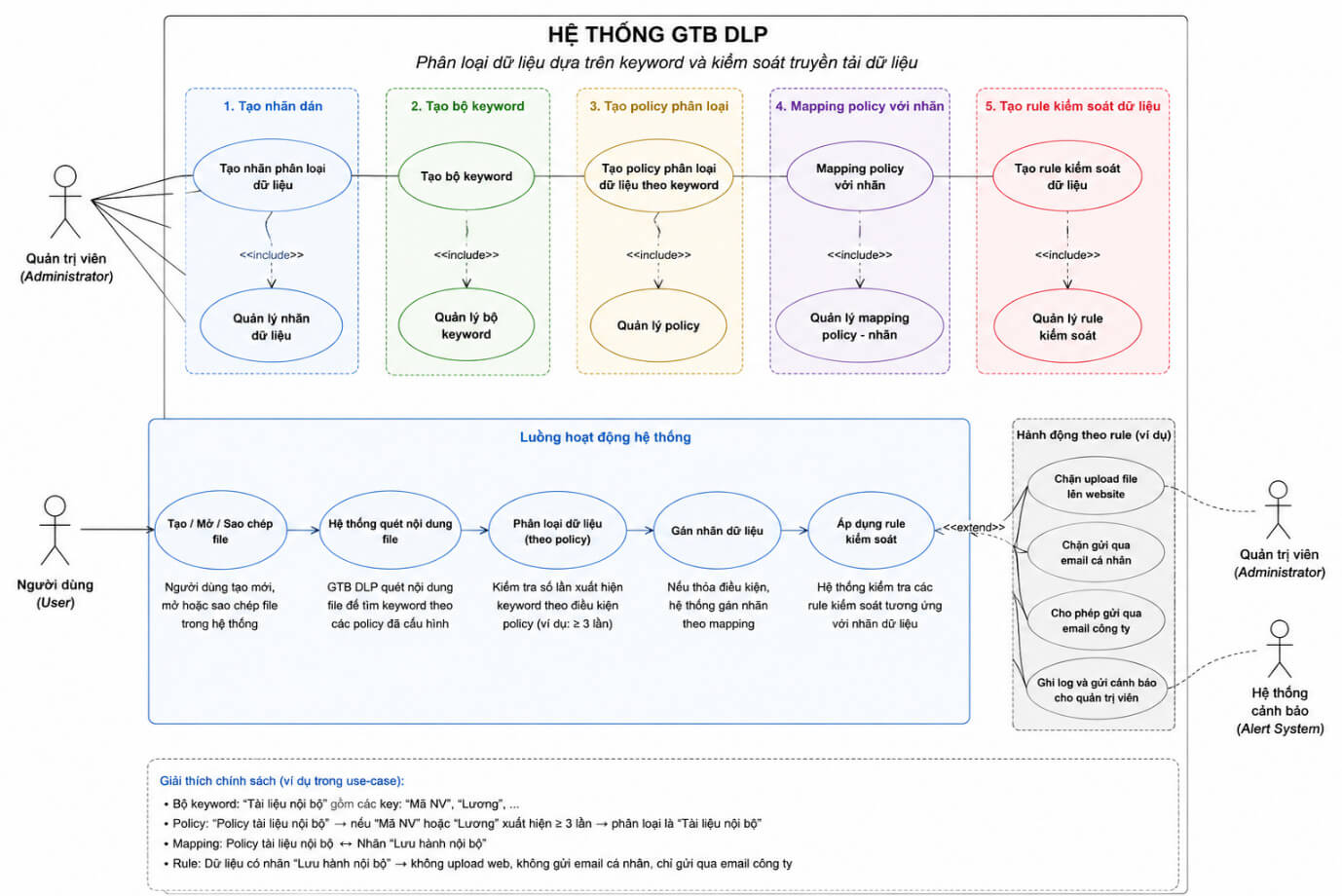
GTB Technologies enables data classification based on enterprise-defined keyword sets. The system can monitor data transmission activities and enforce appropriate security policies.
This mechanism supports a wide range of common document formats, such as .doc, .docx, .xls, .xlsx, .pdf, and .txt.
Classify data based on Regex regular expressions
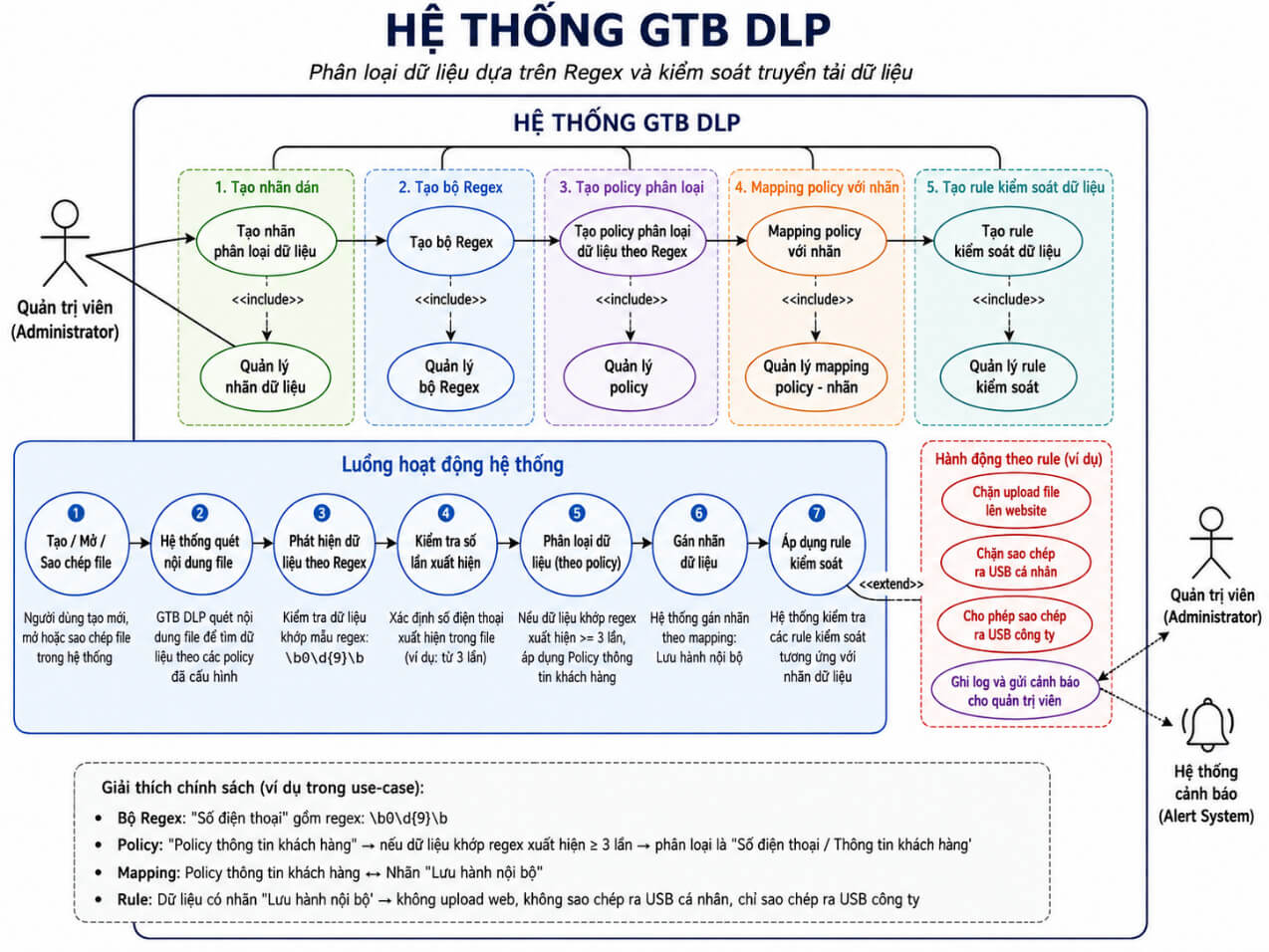
Not all sensitive data can be detected using keywords. Many data types have specific structures that need to be recognized using Regex.
Examples include phone numbers, credit card numbers, personal identifiers, account numbers, or strings of fixed-format information.
GTB Technologies supports Regex-based policy setup to detect complex data patterns. The system can determine how often a data pattern appears in a document. The system then assigns labels and applies appropriate protection policies.
For example, if a document contains multiple pieces of data that resemble sensitive information, the system can determine that this is data that needs to be protected. Control policies can be blocking uploads to websites, blocking copying to USB or blocking sending via messaging applications.
Data classification based on storage path
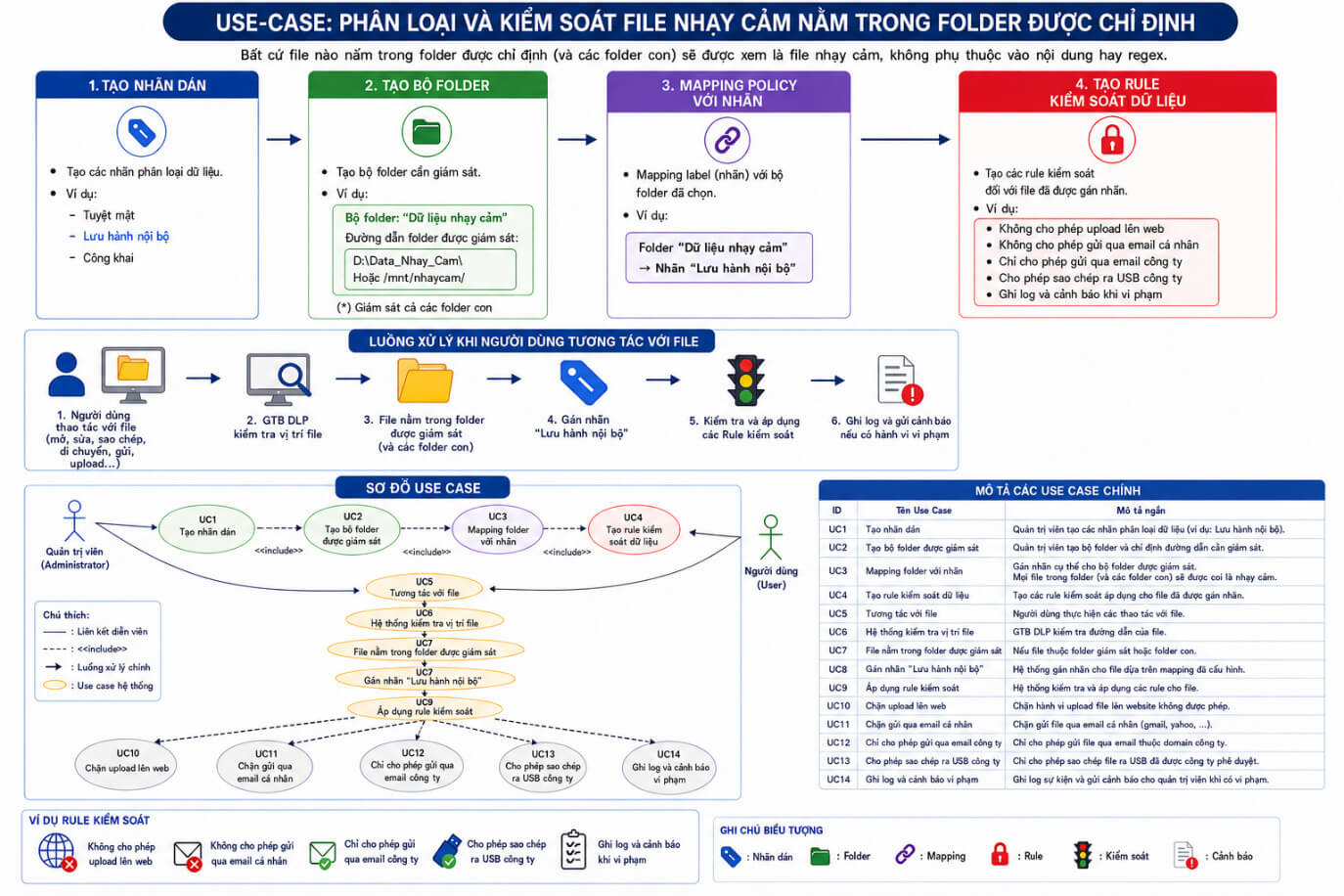
GTB Technologies enables enterprises to establish data control zones based on storage paths.
This mechanism is suitable for directories containing sensitive data—such as finance and accounting folders, customer records, HR directories, or shared folders on file servers.
Examples of paths requiring control include:
D:\Data\Tai Chinh_Ke Toan
\FileServer\Data\Khach Hang
Once configured, all files within these directories are designated as data requiring protection. Actions such as copying, moving, transmitting externally, or uploading files can trigger control policies.
Email data classification and control
Email is a high-risk channel for data leakage. GTB Technologies supports email classification by applying sensitivity or security labels to emails.
This feature helps organizations prevent sensitive information from being sent to the wrong recipients. The system can also require users to label emails before sending them.
Additionally, the solution can automatically assign or upgrade labels based on email content or recipients. Security events are logged to facilitate monitoring and investigations.
The solution supports both Microsoft Outlook Classic and Outlook on the Web. Supported areas include the inbox, drafts, sent items, replies, and forwards.
Email classification policies can be based on sensitive content, recipient email addresses, or domains. For example, emails containing credit card information can be assigned a sensitivity label, while “Top Secret” emails might be restricted to internal domains only.
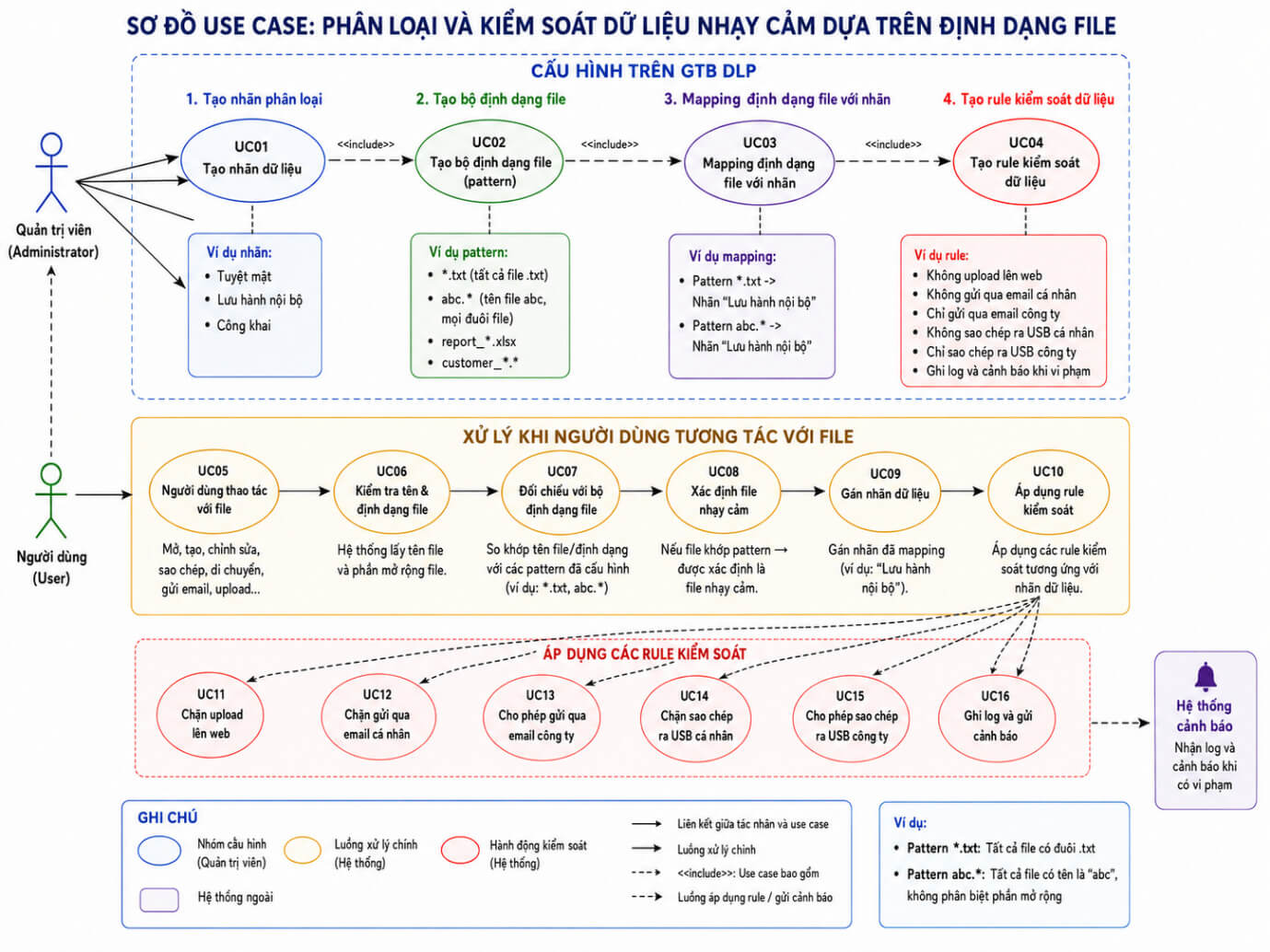
Classify data based on format or file name.
In some instances, organizations need to control data based on file formats or filenames. This requirement applies even when the system does not inspect the file’s internal content.
For example, all `.txt` files might contain raw data exported from a system. A file with a specific, fixed name could represent a recurring report or critical business data. Certain log files, export files, and configuration files may also require protection under dedicated policies.
GTB Technologies allows for the configuration of patterns to control files, such as:
`*.txt` – applies to all files with the `.txt` extension.
`abc.*` – applies to all files named “abc,” regardless of the extension.
`report_*.xlsx` – applies to Excel files with names starting with “report_”.
`customer_.*` – applies to files with names starting with “customer_”, regardless of the extension.
When a file matches a specified pattern, the system can identify it as sensitive data. Control policies can be triggered when a user creates, opens, edits, copies, moves, uploads, emails, or copies the file to a USB drive.
Data classification based on user-assigned labels
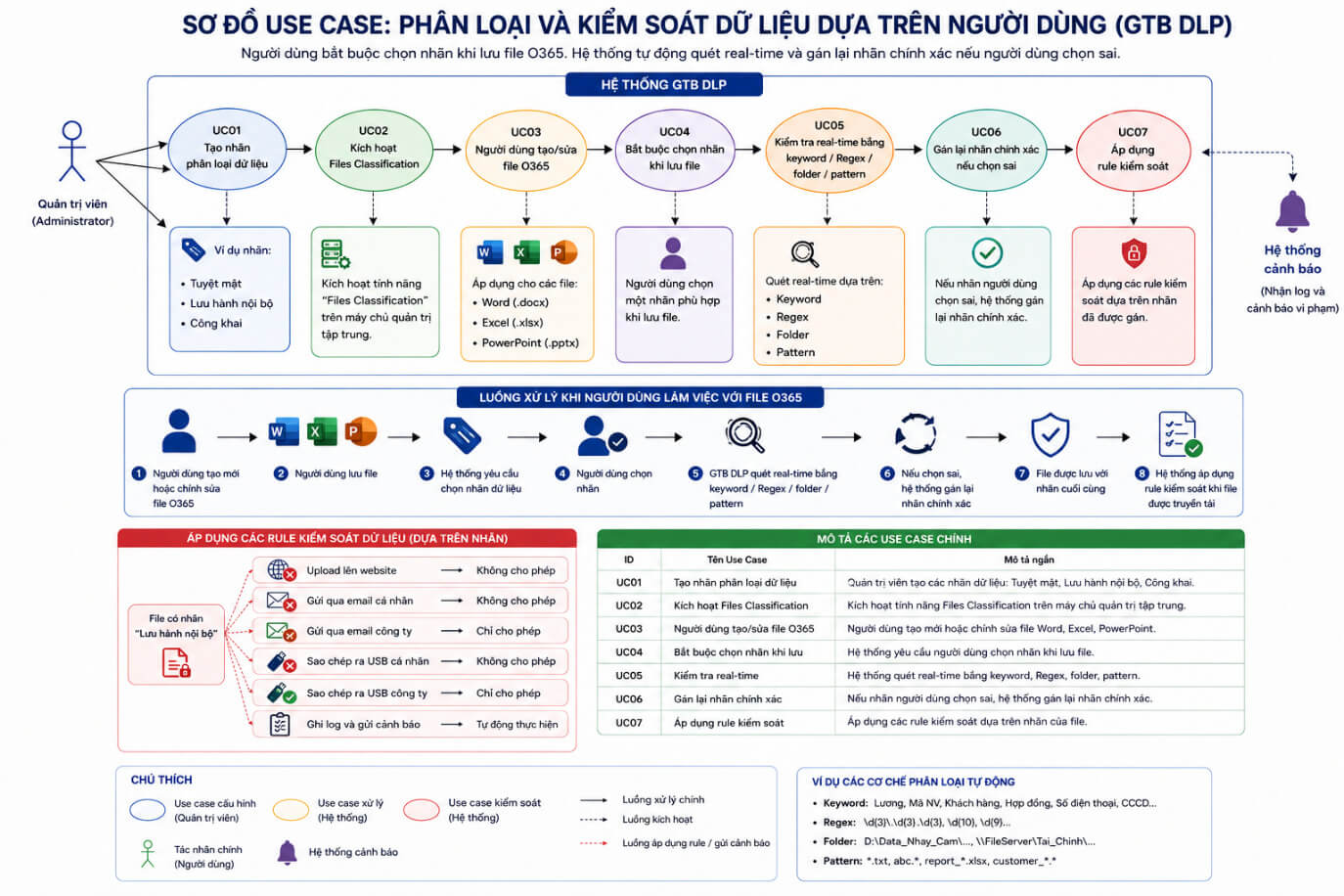
In practice, there are instances where users are permitted to send out documents containing sensitive information. Businesses require a mechanism that is flexible enough to support workflows while still ensuring that evidence is logged and risks are managed.
GTB Technologies enables a combination of manual labeling and real-time automated checks. Users can assign labels to data themselves, after which the management system verifies the actions to prevent the misuse of classification labels.
This mechanism applies to various actions, including creating, editing, and saving Office 365 files, as well as sending files via email, uploading them to websites, or copying them to USB drives.
Supported common formats include .docx, .xlsx, and .pptx.
GTB Technologies Discovery in data classification solutions
In addition to data classification during active use, GTB Technologies offers data discovery capabilities—a crucial component of a comprehensive data classification solution.
GTB Technologies’ discovery solution can automatically scan local endpoints, shared network drives, file servers, NAS devices, cloud platforms, and other storage repositories.
It helps identify unstructured sensitive data—such as personally identifiable information (PII), financial records, intellectual property, or authentication credentials—that traditional security tools might overlook.
The Discovery Server utilizes DLP policies to detect violations and can automatically apply classification labels and execute remediation actions.
These actions may include logging events, copying data to a designated storage area, moving non-compliant data, securely deleting files, or leaving instructional notes for users.
Learn more from GTB Technologies about Data Discovery and Data Classification:
https://gttb.com/data-discovery-data-classification/
Benefits of GTB Technologies Discovery
GTB Technologies Discovery helps enterprises identify “shadow data” and uncontrolled data sprawl.
The solution also enables risk assessment of data stored on endpoints, file servers, databases, or in the cloud.
Enterprises can enforce data minimization and retention policies. The system also supports generating reports for compliance audits, such as GDPR, HIPAA, and PCI DSS.
Additionally, Discovery facilitates continuous monitoring through incremental scanning and real-time surveillance. It supports OCR for images and PDFs, automatically classifies files during scanning, and applies filters based on file type, size, and creation, modification, or access dates.
Data scopes that can be scanned and classified
GTB Technologies Discovery supports a wide range of data scanning capabilities.
Local PC Discovery supports scanning servers and workstations via an Endpoint Agent.
MS Outlook Discovery supports scanning PST/OST data stored on user machines.
File Shares supports scheduled scanning of file servers, shared folders, and NAS systems; this mechanism is suitable for large volumes of data.
MS Exchange supports scanning Exchange Online or on-premises Exchange mail servers.
MS SharePoint helps detect sensitive data within SharePoint Online or on-premises SharePoint environments.
Databases supports identifying sensitive data within database tables and fields.
Cloud Discovery enables API-based integration to scan data across cloud storage platforms such as OneDrive, SharePoint, Google Drive, and similar services.
Protection policy in data classification solutions
TB Technologies enables businesses to establish flexible data scanning and protection policies.
Enterprises can specify the file types to be scanned, such as .docx, .pdf, and .xlsx, while also excluding unnecessary formats like .mp4 or .jpg.
Scanning operations can be triggered based on data modification, creation, or access events. From the second scan onwards, the system can be configured to scan only new or modified files.
Additionally, businesses can opt to list all files without inspecting their internal content—a feature suitable for data inventory purposes.
Remediation actions may include:
Logging data violation events.
Moving violating data to a dedicated storage area for investigation.
Retaining evidence for auditing or incident response.
Adjusting or relocating non-violating data to meet administrative requirements.
Automatically applying classification labels to data.
Implementation plan for a data classification solution for enterprises
An effective data classification project requires a clear roadmap. Enterprises must integrate assessment, policy design, technology configuration, testing, and operational optimization.
Phase 1: Planning the Data Classification Implementation
The enterprise needs to conduct an assessment and define the scope of data classification.
Key objectives include protecting sensitive data, mitigating leakage risks, meeting legal requirements, and ensuring compliance.
The scope of data must be clearly defined. Examples include customer lists, finance and accounting documents, emails, files, databases, and data on endpoint devices.
The organization also needs to establish data-related policies. These policies should be formally documented and include reference numbers, effective dates, and approval details.
Phase 2: Defining Roles and Responsibilities
The enterprise must clearly delineate the roles of stakeholders involved in data governance.
Data Owners bear ultimate responsibility for the data collected and maintained by their respective departments or units.
Data Administrators or IT Security teams are responsible for maintaining systems, databases, storage servers, and backups, as well as implementing security policies.
Data Users are responsible for using data for its intended purpose. Users must also adhere to policies and report any violations or suspected data leaks.
Phase 3: Executing the Data Classification Process
The enterprise needs to create a data inventory to catalog the data it holds.
Data can be classified by department—such as IT, finance and accounting, human resources, operations, and other relevant units.
Next, the organization determines the sensitivity level of the data. Levels may include Public, Internal Use, Confidential, or Restricted.
The classification process needs to address core questions:
What: What types of data does the organization hold? Who: To whom does the data belong?
Why: What are the legal basis and purpose of data processing?
Where: Where is the data stored?
When: When is the data collected and how long is it retained?
How: How is the data collected?
Stage 5: Finalizing the data classification matrix
The final stage involves developing the formal data classification matrix.
The enterprise also needs to finalize relevant data management documentation. This serves as the foundation for operating, auditing, evaluating, and improving the data protection program.
Implementation Plan for GTB Technologies Data Classification
Technically, the deployment process for GTB Technologies Data Classification involves several stages.
The first step is setting up the operating system servers for the DLP management and data classification components. This infrastructure is deployed within the resource environment provided by the enterprise.
Next, connectivity configurations, as well as administrative and operational policies, are established.
The deployment team installs the management components and agents on the organization’s machines. Subsequently, the system undergoes testing, and the data classification module license is activated.
During the deployment phase, Sonic can assist with information gathering and the analysis of Data Loss Prevention requirements. The technical team also provides consultation on system design and deployment strategies tailored to the actual environment.
Once the plan is finalized, the system is installed or integrated. Data loss prevention policies are configured in accordance with the enterprise’s requirements.
Agents are installed on computers within the deployment scope, and DLP policies are subsequently tested and evaluated.
During the initial operational phase, the system requires monitoring and optimization. The objective is to ensure policies function as intended, minimize false-positive alerts, and avoid blocking legitimate actions.
Finally, the system undergoes testing, formal acceptance, and handover. Training is also provided to ensure administrators are capable of installing, configuring, and operating the solution.
Benefits of the GTB Technologies and Sonic Data Classification Solution
As a technology solution provider and consultant in Vietnam, Sonic partners with enterprises to assess needs, design policies, implement solutions, and optimize the operation of GTB Technologies Data Classification.
The GTB Technologies data classification solution enables enterprises to accurately identify sensitive data across their entire system.
It also enhances data control across endpoints, networks, email, file servers, databases, and cloud environments.
Enterprises can mitigate the risk of data loss via email, USB drives, web uploads, OTT applications, and other transmission channels.
The system optimizes the effectiveness of DLP and SOC/SIEM operations while supporting compliance with legal requirements and data security standards.
GTB Technologies Data Classification also improves visibility into unstructured and distributed data, facilitating better investigation, auditing, and evidence retention in the event of an incident.
Crucially, the solution strikes a balance between security and the enterprise’s daily operational performance.
Conclude
Implementing data classification and control is more than just a technology project; it is a strategic move toward building a robust foundation for information governance and security.
Amidst the data explosion, increasingly distributed work environments, and tightening regulatory requirements, businesses must accurately identify their digital assets.
GTB Technologies Data Classification enables enterprises to proactively discover, classify, monitor, and control data based on context. The solution helps safeguard data throughout its entire lifecycle.
With Sonic, businesses can adopt the GTB Technologies data classification solution through a structured approach—spanning data assessment, policy development, and technical implementation to post-deployment operational optimization.
Investing in data classification is an investment in risk management capabilities, brand reputation, and the enterprise’s sustainable growth in the digital era.
👉 Explore other cybersecurity solutions at:
https://sonictech.com.vn/
————————–
Sonic Technology Solutions Joint Stock Company (Sonic Technology)
Hanoi: 8th Floor, Licogi 13 Building, 164 Khuat Duy Tien, Thanh Xuan Ward, Hanoi
Ho Chi Minh City: 1st Floor, Zone A, Waseco Building, 10 Pho Quang, Tan Son Hoa Ward, Ho Chi Minh City
Hotline: 024.6656.4587
Email: sales@sonic.com.vn
Fanpage Facebook: https://www.facebook.com/SonicTechnology.Jsc
Zalo OA: https://bit.ly/Sonic_Zalo